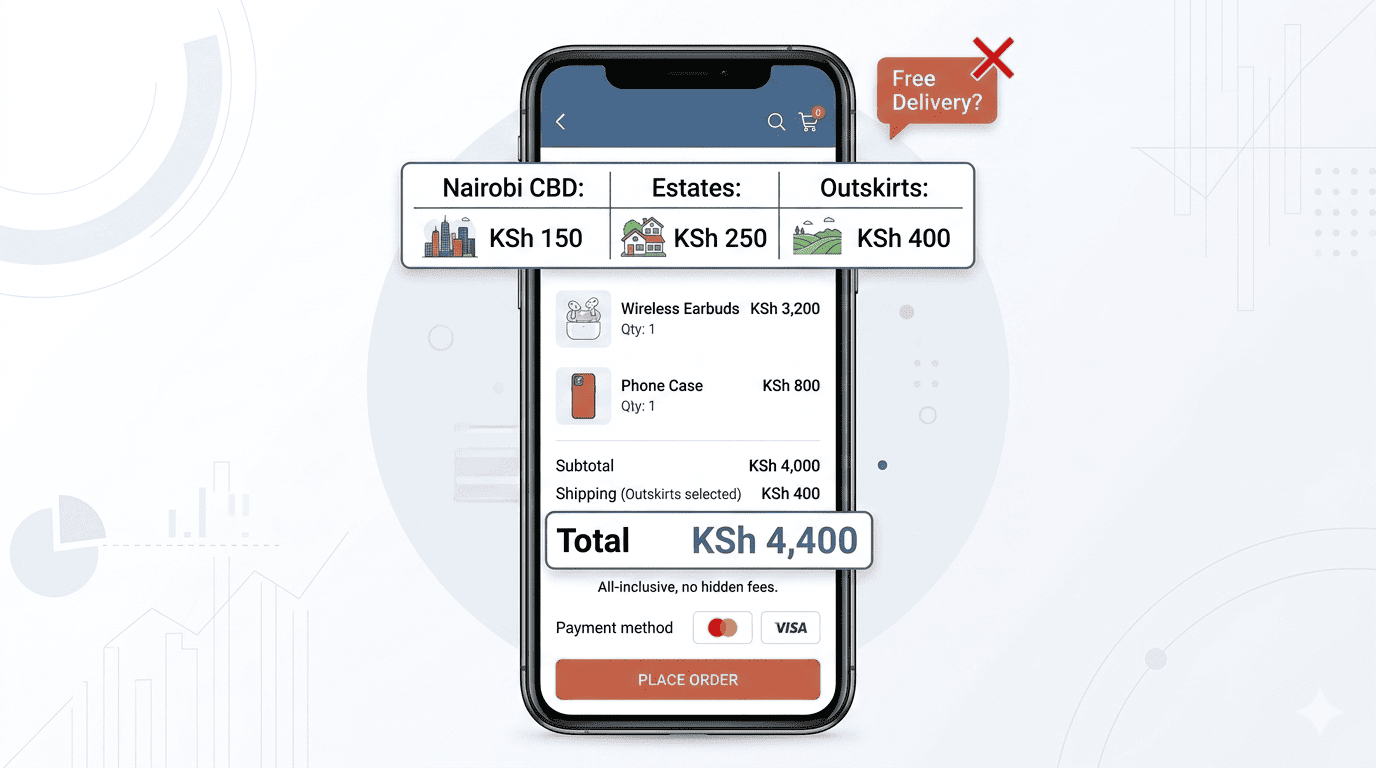
The "Free Delivery" Trap
You see international e-commerce giants offering "Free Shipping" and think you must do the same to compete. So you plaster "Free Delivery in Nairobi!" on your Kenyan e-commerce site. Then you quietly absorb the delivery cost—KSh 200 to 400 per order—into your margins. You feel generous. You feel competitive.
But here's the data: Kenyans don't actually expect free delivery. What they expect is clear, fair, and predictable delivery pricing. A hidden delivery cost that emerges at checkout is what kills conversions. A visible, reasonable delivery fee does not.
The Psychology of Delivery Fees in Kenya
Kenyan consumers are accustomed to paying for transport. They pay for bodaboda, for matatus, for courier services daily. The idea of paying to get goods moved is not foreign to them. The friction arises when the fee is a surprise.
In A/B tests we've run for clients, displaying a clear, flat-rate delivery fee upfront (e.g., "KSh 200 delivery to Nairobi Estates") resulted in 12% higher checkout completion than a "Free Delivery" offer that was later clawed back with a minimum order value, or that silently raised product prices to cover the cost.
The Stonehenge Digital "Fair Fee" Framework
Instead of "Free Delivery," use one of these three transparent pricing models:
1. Flat-Rate by Zone
Display a simple table on every product page and at the top of the checkout:
- Nairobi CBD & Immediate Environs: KSh 150
- Greater Nairobi Estates: KSh 250
- Kitengela, Syokimau, Ruiru: KSh 400
This is predictable, fair, and based on a real cost driver (distance).
2. Free Delivery Over a Threshold (But Transparent)
"Free delivery on orders over KSh 3,500." This encourages larger baskets. But be clear: "Orders below KSh 3,500: flat KSh 200 delivery." Don't hide the fee until checkout.
3. "Delivery Fee Included" Pricing
If you really want to offer "free delivery," build the average delivery cost into your product price and don't mention delivery as a separate line item. The total price the customer sees is the total price they pay. This works best for items with consistent delivery costs (e.g., a fixed box size).
What to Avoid
- "Delivery calculated at checkout." This is the #1 abandoner. The customer fears the unknown.
- Hiding the delivery fee in "taxes and fees." Be specific. Kenyans appreciate honesty.
Your delivery fee is not a penalty. It's a service charge. Treat it as such, present it clearly, and your customers will accept it.
Interested in E-Commerce Website with M-Pesa?
Let's build this for your business
Sell to any Kenyan with a phone. Full online shop with Safaricom STK Push payment — no card needed.