The Great M-Pesa Business Wallet Debate
M-Pesa Pochi La Biashara is the new darling of Safaricom's business ecosystem. It's free to set up, it auto-separates business and personal funds, and you can even apply for loans based on your Pochi activity. But can it replace a full STK Push e-commerce integration? Or does it just paper over the cracks of manual reconciliation?
At Stonehenge Digital, we've analyzed both tools against the needs of Kenyan SMEs at different stages of growth. Here is the definitive comparison.
Pochi La Biashara: The "Free Float Fortress"
Strengths:
- Completely free to register and receive payments (no transaction fee for merchant).
- Funds go into a separate wallet, so your float is never mixed with personal airtime money. This is a game-changer for small, unbanked traders.
- You can withdraw to M-Pesa, bank, or an agent. No minimum balance.
- The Pochi statement can be used as proof of income for Fuliza limit increases and eventual M-Shwari loans.
Weaknesses:
- Zero automation. Payment is just a Till Number under the hood. No auto-reconciliation with an order management system. You still get a long list of "Customer Paid KES X" entries with no context.
- Can't pre-set an exact amount. Customer can send KES 200 on a KES 2,000 item. The fight for top-up continues.
- No customer data capture. You don't know who paid unless they voluntarily add a reference.
STK Push Integration: The "Automated Revenue Engine"
Strengths:
- Exact amount pre-filled. Customer pays KES 2,000 or nothing. Eliminates underpayment and manual top-up chasing.
- Auto-reconciliation: Order #1099 automatically marked as "Paid" in your dashboard. M-Pesa statement shows "Order #1099 - KES 2,000." End-of-month bookkeeping is 10 minutes, not 3 hours.
- Customer data capture at checkout (phone, email, delivery address). Builds your CRM.
- Professional brand experience. The STK pop-up says "Stonehenge Client" which signals legitimacy.
Weaknesses:
- Transaction cost (C2B: ~0.5% capped; B2C: ~KES 45 per transaction for amounts under KES 2,500). This is a direct cost on revenue.
- Technical complexity. Requires API integration (Daraja). Needs a developer to maintain.
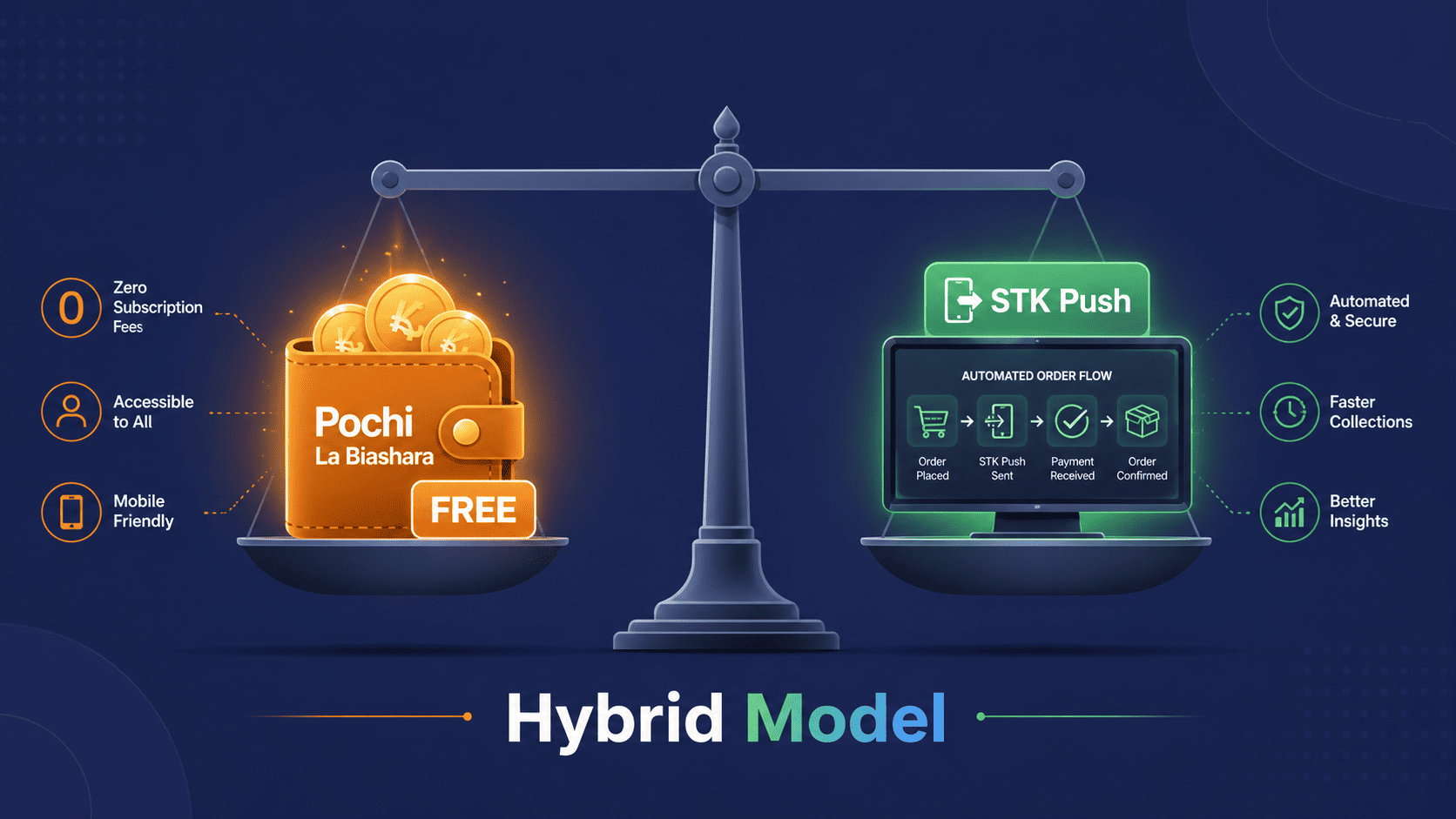
The Stonehenge Digital Recommendation: The Hybrid Model
Use both, but for different purposes:
- For low-value, high-volume walk-in or off-the-street sales: Use Pochi La Biashara. It's free and clean. Have it displayed in your shop. The float is protected. You can manually log the sales later.
- For online, pre-ordered, or delivery-based sales: Use STK Push integration on your website. The automation saves labor cost and errors far exceeding the transaction fee.
Don't choose one over the other. Choose the right tool for the right channel. And let your website dashboard aggregate the data from both into one P&L statement.
Interested in E-Commerce Website with M-Pesa?
Let's build this for your business
Sell to any Kenyan with a phone. Full online shop with Safaricom STK Push payment — no card needed.
10 Comments
Mama Jimmy (Clothes Vendor)
28 Apr 2026
I've been confused about Pochi vs. STK. This cleared it up perfectly. I use Pochi for my market stall and STK for my Instagram orders. Keeps things clean.
Brian O. (E-Commerce Startup)
28 Apr 2026
The "Hybrid Model" is exactly what we do. Pochi for walk-in pickups at our collection point, STK for website orders. The key is the dashboard unifying both. One question: Pochi statements are in a weird format when you export them as PDF. Does the Stonehenge dashboard automatically ingest Pochi transaction data, or do we still have to manually reconcile it? Because that still burns time. If I could just upload the Pochi M-Pesa statement and have it match, that would be ideal.
Akinyi W.
28 Apr 2026
I didn't know STK Push auto-reconciles the order number into the M-Pesa statement. That's a massive time-saver. I'm switching my online orders to STK.
Kevin M.
28 Apr 2026
The point about Pochi being "just a Till Number under the hood" is important. It's marketed as new, but the underlying friction (wrong amounts, no context) is the same.
Wanjiku F.
28 Apr 2026
I love Pochi because it's free and my float is separate. But yes, reconciliation is still manual. The hybrid model is the way.
Otieno S.
28 Apr 2026
For a small shop doing maybe 10 orders a day, is the STK integration fee worth it? Or should I stick with Pochi until I scale?
Grace N.
28 Apr 2026
The "Professional Brand Experience" of STK Push is underrated. When a customer sees a branded prompt, they trust you more. It's like having a shop counter vs. selling on a blanket.
Faith J.
28 Apr 2026
This is such a balanced, useful comparison. Not just hype for one or the other. Real practical advice.
James K.
28 Apr 2026
I'm using Pochi for all sales now after reading this. I'll upgrade to STK when my online volume justifies the dev cost. Staged approach.
Mercy L.
28 Apr 2026
The Pochi statement for loan applications is a great feature. If I can build a history on Pochi and then get a loan to invest in an STK-integrated site, that's a nice growth path.