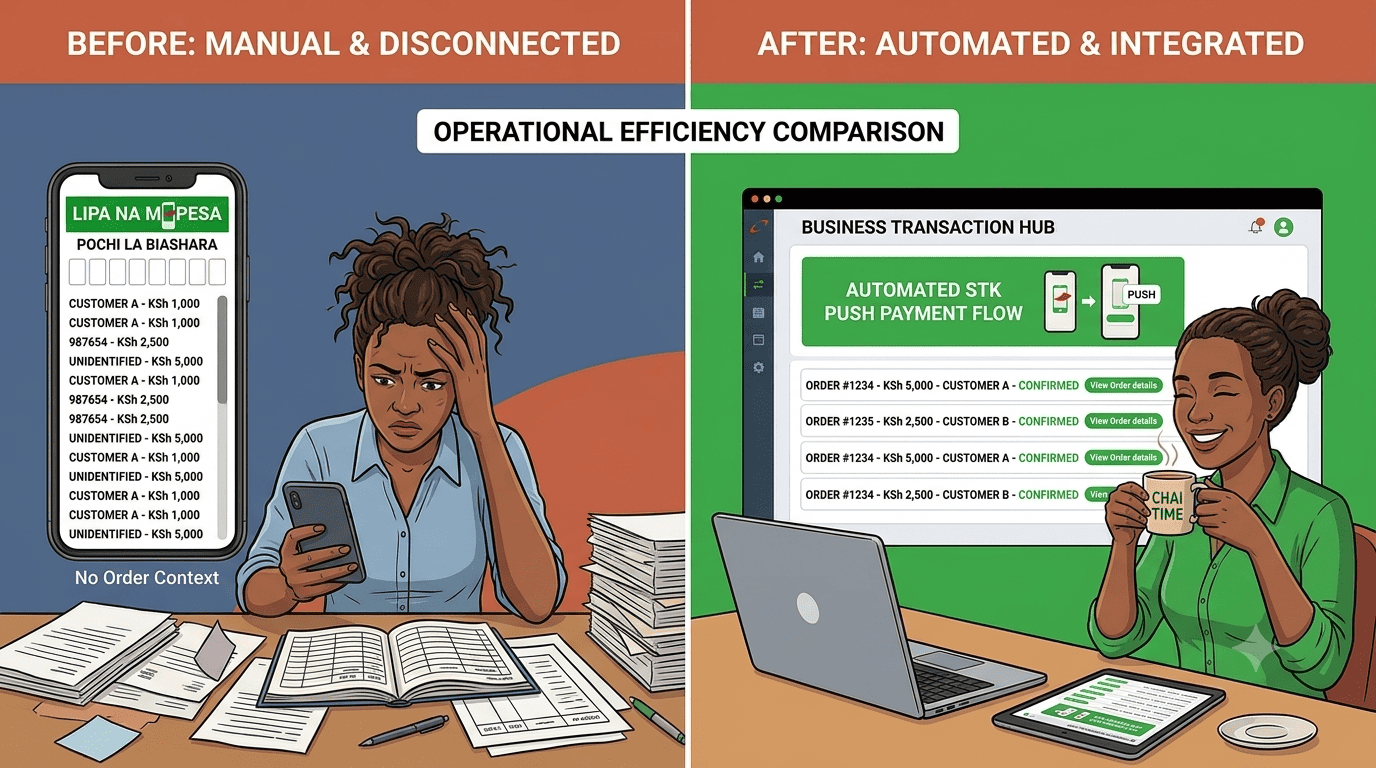
The Free Tool That's Costing You More Than You Think
When Pochi La Biashara launched, it was hailed as the saviour of the small Kenyan trader. Free to use, separates business from personal funds, no transaction fees. For many, it was a revelation. But six months into heavy usage, a quiet exodus is happening. SMEs who have scaled beyond 20-30 orders a day are abandoning Pochi and switching to STK Push integration.
Why? Because the "free" tool has hidden costs: reconciliation nightmares, statement delays, lack of automation, and Fuliza clawback risks. Here is the honest confession from business owners who've made the switch.
The Five Pain Points Driving the Pochi Exodus
1. The Reconciliation Black Hole
Pochi gives you a statement, but it's just a list of amounts and phone numbers. No order numbers, no customer names. If you process 50 orders a day, matching those 50 Pochi entries to 50 orders in your notebook or system is a daily 2-hour headache. STK Push automatically tags every payment with an order ID.
2. Statement Delays
Pochi statements are not real-time. There's often a lag of several hours, or even until the next day, before transactions appear. This delays dispatch and angers customers who want instant confirmation. STK Push confirmations are near-instant.
3. Fuliza Clawbacks
Pochi transactions, like regular Till payments, are subject to Fuliza reversals. A customer can pay, you release goods, and Safaricom reverses the payment later because the customer's Fuliza limit was breached. Pochi doesn't protect you from this. STK Push, while also not immune, allows for faster detection and automated order holds.
4. No Customer Data Capture
Pochi captures the phone number, but no name, no email, no delivery address. You can't build a customer list. STK Push, integrated with a checkout form, captures all this data for remarketing.
5. Limited Scalability
Pochi works beautifully for a kiosk or a small shop with 10 walk-in customers a day. It fails for a growing e-commerce business with 50+ orders needing automated processing, tracking, and customer communication.
The STK Push Investment That Pays for Itself
Yes, STK Push has transaction fees (around KSh 10-50 depending on volume). But the time saved on reconciliation, the reduced customer complaints, the captured customer data, and the improved cash flow visibility pay for those fees many times over. One business owner we spoke to calculated that the 2 hours daily she saved on reconciliation alone was worth KSh 30,000 a month in her own time—far exceeding the STK fees.
Pochi is a great entry-level tool. But if you're serious about scaling your online business, it's time to graduate to STK Push.
Interested in E-Commerce Website with M-Pesa?
Let's build this for your business
Sell to any Kenyan with a phone. Full online shop with Safaricom STK Push payment — no card needed.