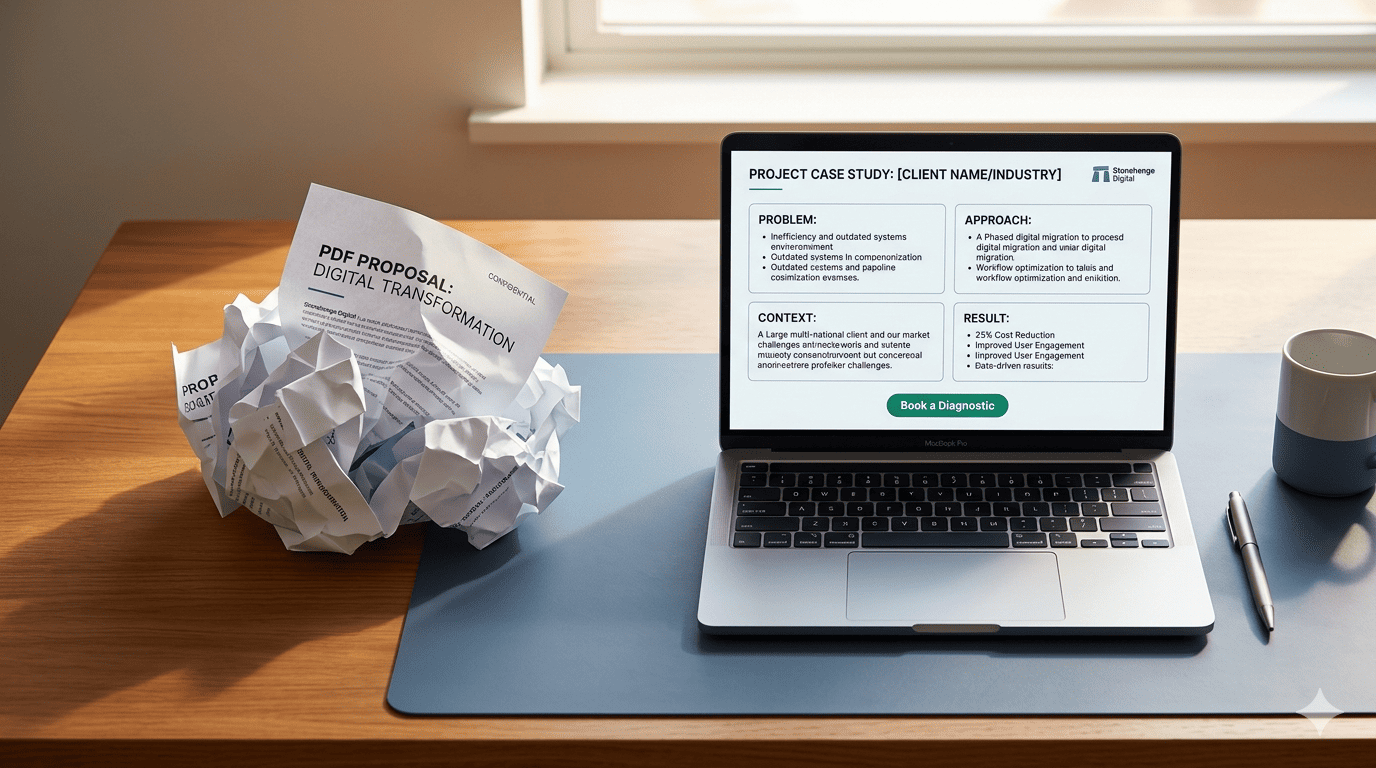
The 20-Page Proposal Is Dead
You are a management consultant. A potential client in Upper Hill sends a polite email: "We are scoping a project. Can you send us your company profile and a proposal?" You spend the next three days crafting a bespoke, 20-page PDF detailing your methodology, your past projects, and your fees. You email it. And you wait.
In the meantime, your competitor, who has a well-structured website, simply sends a link: yourbrand.co.ke/work/strategic-planning-for-financial-institutions/. They get the meeting before you even finish designing the cover page of your PDF.
The modern Kenyan consultancy website should be the proposal. Here is the Stonehenge Digital strategy for turning your site into a deal-closing machine.
The "Proposal-as-a-Page" Framework
Create a dedicated "Work" or "Projects" section, but structure each project page as a mini-proposal that follows the exact logic a corporate buyer uses to evaluate a vendor.
Section 1: The Client Situation (The "Problem" Slide)
Start with the business challenge. "A Tier-2 bank in Nairobi was experiencing 15% annual churn in its SME lending portfolio. Manual underwriting was causing 6-week turnaround times, and clients were defecting to fintechs."
Section 2: Our Approach (The "Methodology" Slide)
Briefly describe your unique process. "We implemented a 3-phase engagement: diagnostic audit of the credit department, co-designed a new digital credit scoring model, and trained 40 relationship managers on the new tool."
Section 3: The Kenyan Context (The "Why Us" Slide)
Explicitly state the local nuances you navigated. "The project required integrating the new scoring model with the bank's existing T24 core banking system and accommodating the reality that many SME borrowers had only M-Pesa statements, not formal payslips."
Section 4: The Verified Result (The "ROI" Slide)
Use numbers and, ideally, a client quote. "The bank reduced loan processing time from 6 weeks to 4 days. SME loan book grew 22% in 12 months. - Jane W., Head of SME Banking."
Section 5: The "Similar Engagement" CTA (The "Next Step" Button)
End with a tailored call to action: "Looking for similar results in your financial services firm? Let's discuss a diagnostic."
Why This Works Psychologically
A PDF proposal is a static document that feels like a one-time ask. A website project page is a living asset that signals: "We do this kind of work repeatedly. We are specialists, not generalists bidding for a one-off gig." It's the difference between a freelancer and a firm.
Furthermore, your website is always "on." While you sleep, a procurement officer in London evaluating a Kenyan partner can land on your project page and essentially read your entire sales pitch without you lifting a finger.
The Pitch: Send a Link, Not a PDF
Next time a client asks for a proposal, reply: "I'd love to. In the meantime, you might find our work with [Similar Client] on our site illustrative of our approach: [Link]. I'll tailor our proposal to your specific needs based on this framework."
You've now set the expectation of a proven methodology, not a generic cut-and-paste document.
Interested in Portfolio & Organisational Website?
Let's build this for your business
A professional, mobile-first website that makes your business look credible and gets found on Google.