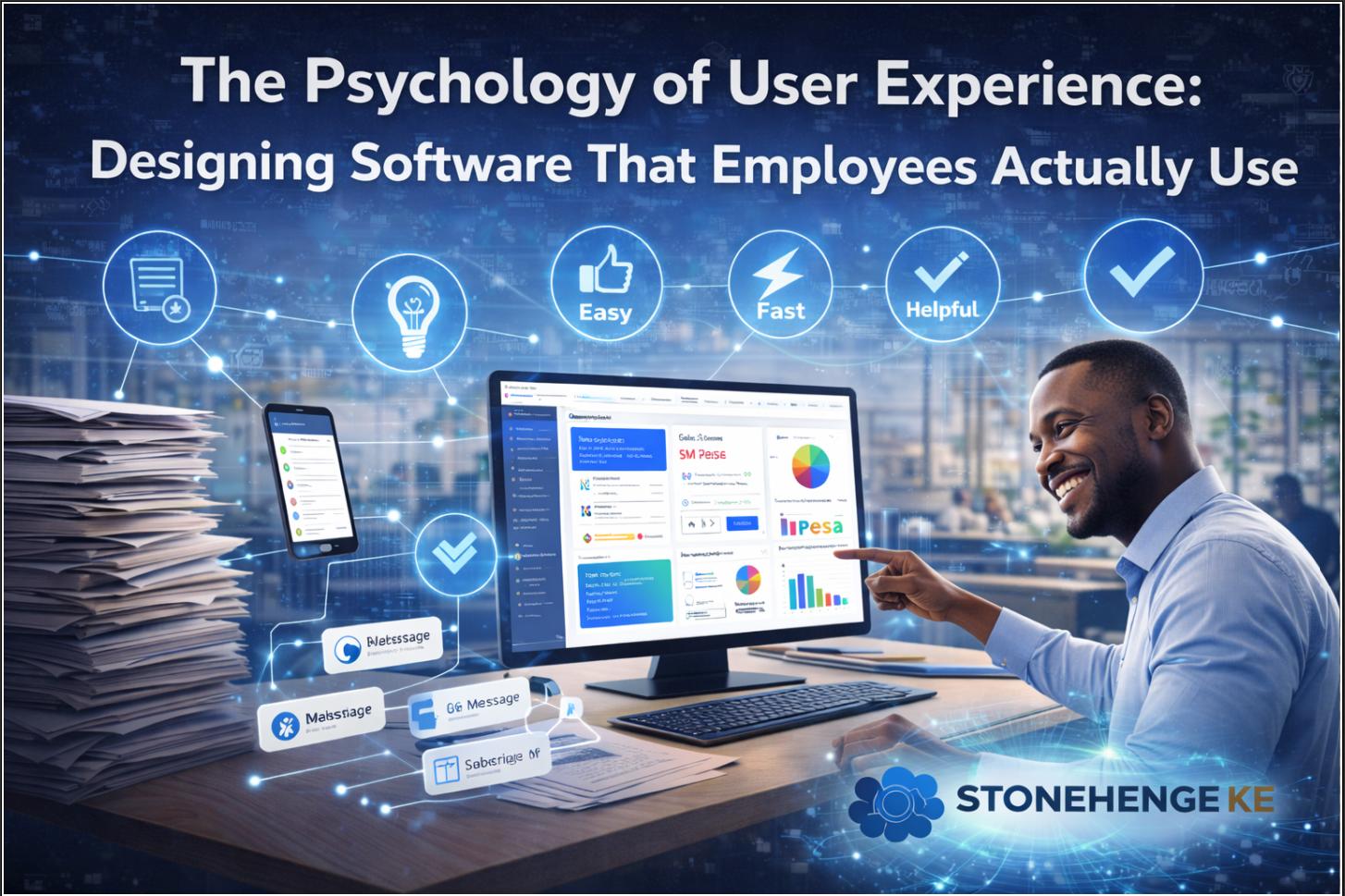
The Psychology of User Experience: Designing Software That Employees Actually Use
By the CEO & Founder, Stonehenge KE
📅 Monday, 6th April 2026
In many organizations, a familiar pattern continues to emerge:
A company invests in software. The rollout is announced. Training is conducted. Expectations are high.
And then—silence.
Weeks later, employees quietly return to spreadsheets, manual logs, and WhatsApp threads.
The system exists, but it is not being used.
This is not a failure of technology. It is a failure to understand human behavior.
At Stonehenge KE, we approach software development differently. We don't just build systems—we design experiences that people actually want to use.
Adoption Is the Real ROI
Businesses often measure software success by features, cost, or technical performance. But the true return on investment lies in adoption.
If employees avoid the system, its value drops to zero.
Every user interaction is shaped by a simple internal calculation:
- Is this easy?
- Is this fast?
- Does this help me, or slow me down?
If the answer is unclear, resistance begins immediately.
Cognitive Load: Why Simplicity Wins
One of the most critical principles in user experience is cognitive load—the mental effort required to use a system.
When software is cluttered, unintuitive, or overly complex, users experience friction. This leads to hesitation, mistakes, and eventually, avoidance.
Employees will always choose the path of least resistance.
This is why simplicity is not just a design preference—it is a business strategy.
At Stonehenge KE, we prioritize:
- Clear, predictable interfaces
- Minimal steps to complete tasks
- Logical workflows that reduce thinking
The best systems feel obvious from the first click.
Familiarity Drives Behavior
Humans are creatures of habit.
Employees often resist new systems not because they are ineffective, but because they disrupt familiar routines.
This is why many teams cling to spreadsheets or messaging platforms—they are comfortable, predictable, and привычны.
Effective UX design bridges this gap by:
- Using familiar design patterns
- Maintaining consistency across screens
- Reducing the learning curve
Software should feel like a natural extension of existing workflows—not a complete reset.
Feedback Builds Trust
A system that does not communicate creates uncertainty.
When users take action, they need immediate, clear feedback:
- Confirmation messages after completing tasks
- Real-time updates in dashboards
- Instant transaction verification via platforms like M-Pesa
These interactions may seem small, but they are critical.
They reassure users that the system is reliable, responsive, and worth trusting.
Designing Around Real Work
One of the most common mistakes in software development is designing in isolation.
Too often, systems are built based on assumptions rather than actual workflows.
At Stonehenge KE, we begin with observation:
- How do employees currently perform their tasks?
- Where are the inefficiencies?
- What shortcuts are they already using?
We then design systems that align with these realities.
When software reflects how work actually happens, adoption becomes effortless.
Less Features, More Impact
There is a persistent myth in software development: more features equal better software.
In reality, excess functionality often creates confusion.
High-performing systems focus on:
- What users need most
- What actions they perform daily
- What slows them down
Everything else is noise.
By removing unnecessary complexity, we create tools that are faster, clearer, and more effective.
The Competitive Advantage of Great UX
In today's digital economy, businesses are no longer competing on products alone.
They are competing on systems.
Organizations that invest in user-centered design experience:
- Higher employee productivity
- Faster onboarding
- Reduced operational errors
- Stronger data accuracy
- Better decision-making
Most importantly, they maximize the value of every system they deploy.
Building Software People Choose to Use
At Stonehenge KE, we believe the best software is not the most powerful.
It is the most usable.
Technology should not feel like an obligation. It should feel like an advantage.
As Kenyan businesses continue to digitize, the difference between success and failure will not be who adopts software—but who adopts software that people actually use.
Because in the end, systems do not transform businesses.
People do.
CEO & Founder
Stonehenge KE 🚀
Interested in Business Management System?
Let's build this for your business
Replace spreadsheets, paper records, and WhatsApp chaos with a custom system built for exactly how your business works.
12 Comments
Joram Otieno
07 Apr 2026
This is a loud truth! I’ve seen my team struggle with a CRM that looked like it was designed in the 90s. We eventually went back to a shared Google Sheet because it was "faster." UX is everything.
Sarah Wambui
07 Apr 2026
As an HR Manager, the "Adoption is the Real ROI" part is my favorite. We spend millions on ERPs, but if the staff find it "heavy," they will just find workarounds. Great piece, Stonehenge KE.
Kipchumba Bett
07 Apr 2026
In the dairy sector, we tried a milk-tracking app, but the farmers found the interface too busy. They prefer SMS. If software doesn't feel like a "natural extension," it’s dead on arrival.
Amina Abdi (Garissa)
07 Apr 2026
Minimal steps to complete tasks—this is key. Especially in regions where internet might be unstable, a "heavy" UI that takes forever to load just frustrates the user. Keep it light and logical.
Kevin Mutua (Machakos)
07 Apr 2026
I’m a developer, and often the client asks for every feature under the sun. We call it "feature creep." I’ll be sharing this article with my clients to explain why "Less is More."
Fatuma Zeinab (Malindi)
07 Apr 2026
The CEO mentions M-Pesa integration as feedback. This is so true. That "beep" and the instant SMS confirmation are psychological anchors. Software should provide that same level of instant reassurance.
Stephen Kiptoo (Eldoret)
07 Apr 2026
"Simplicity is a business strategy." I will be using this phrase in my next board meeting. It’s a game-changer.
Gilbert Nyasani (Kisii)
07 Apr 2026
Can we get a Part 2 of this article focusing on "Mobile UX" specifically? Most of Kenya is mobile-first, and those small screens are even harder to design for.
Dorcas Chebet (Litein)
07 Apr 2026
"Logical workflows that reduce thinking." This is the dream! My brain is already tired from calculating costs; I don't want to calculate how to use the software.
Benson Wambua (Mtito Andei)
07 Apr 2026
I run a stop-over restaurant. My staff use a tablet for orders. The "Logic" must follow the "Customer Flow." First drinks, then food, then bill. If the app asks for the bill first, it’s broken.
Omar Swaleh (Mtwapa)
07 Apr 2026
The "Silence" after a rollout is the most expensive thing in corporate Kenya. It's time we start measuring "Usage Rates" instead of just "Installation Rates."
Noelle Moraa (Nyamira)
07 Apr 2026
We need more CEOs who think like this. Technology is a tool, not a trophy. You don't "win" just by having it; you win by using it.