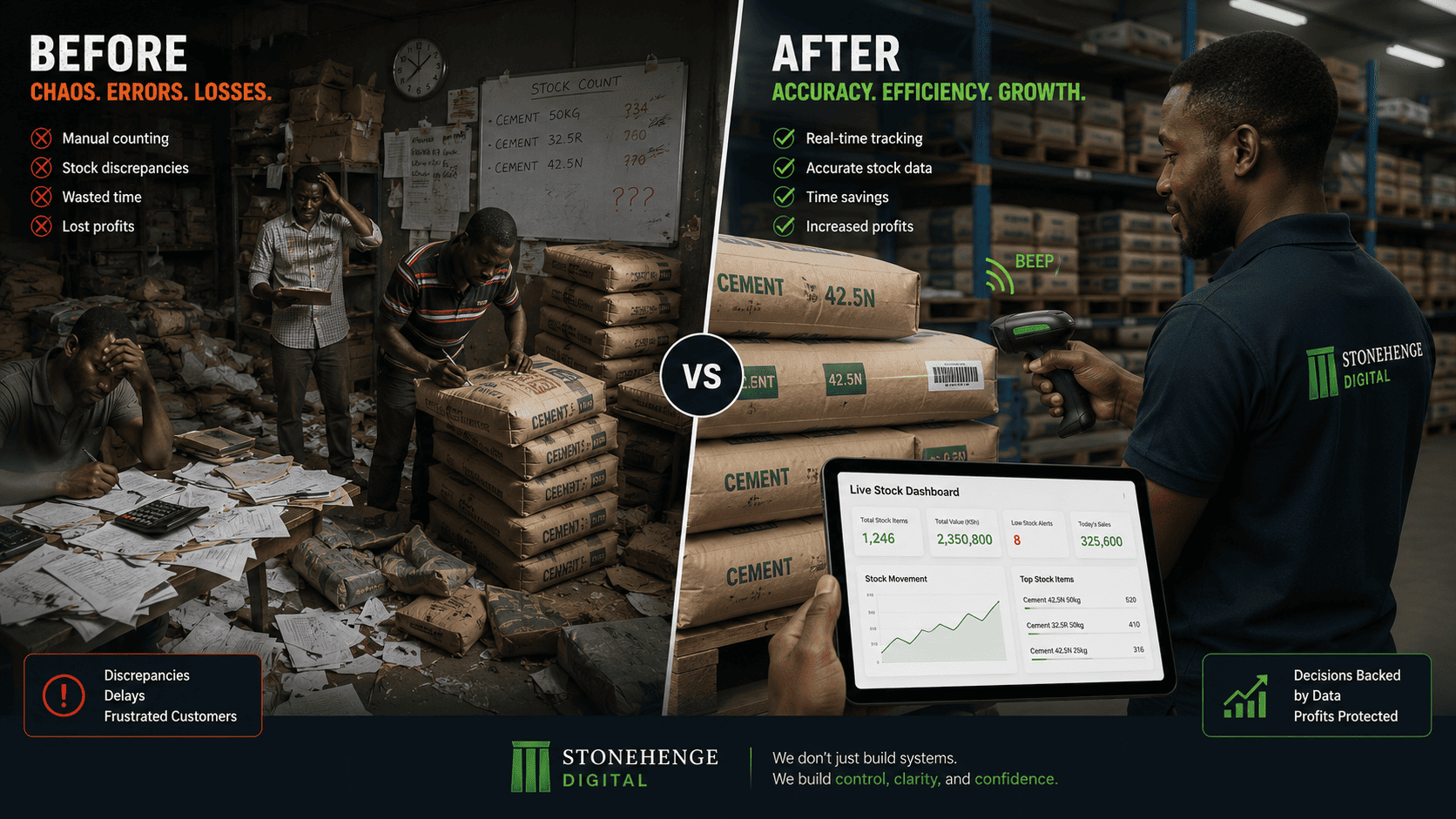
The Weekend Stock Take Prison
Every month-end, you close your hardware shop for two days. You, your manager, and two casual laborers manually count every bag of cement, every box of nails, every tin of paint. You scribble numbers on paper. You lose count. You start over. By Sunday evening, you're exhausted, your back aches, and the numbers are probably still wrong.
This is the traditional Kenyan SME stock take. It costs you two days of sales, labor for the counters, and a lot of sanity.
One of our clients, a hardware store in Industrial Area, switched to a barcode scanner + Stonehenge Digital dashboard system. Their monthly stock take now takes 4 hours, not a full weekend. Here's how it works.
The Barcode + Dashboard Stock Take Workflow
Step 1: Barcode Everything (One-Time Setup)
Each product in your inventory gets a unique barcode. You can either use the manufacturer's barcode (if it's a standardized product) or print your own labels using a simple thermal printer (KSh 8,000-15,000). The barcode links to the product in your dashboard with all its details: name, cost price, selling price, current stock count.
Step 2: The Stock Take Session
On stock take day, you open the "Stock Take" module on the dashboard. You (or your staff) walk through the shelves with a Bluetooth barcode scanner (or a smartphone with a scanner app). Beep. Scan a bag of cement. The dashboard asks: "Quantity?" You type "48" or scan each bag if they're individually barcoded. The dashboard automatically adds 48 units to the count for that SKU.
Step 3: Real-Time Variance Alerts
As you scan, the dashboard compares the physical count to the system's expected stock level. If there's a mismatch (e.g., system says 50 bags, physical count is 48), it flags it immediately: "Cement 50kg: Expected 50, Counted 48. Variance: -2." You can re-count that item on the spot to verify, rather than discovering the error hours later in a spreadsheet.
Step 4: Instant Stock Take Report
When the last item is scanned, the dashboard generates a complete Stock Take Report: total items counted, total variance value, list of discrepancies. This report is your new inventory baseline until the next cycle. It's accurate, auditable, and took 4 hours instead of 16.
The Cost Savings
The hardware store saved:
- Two days of closure (recovered ~KSh 30,000 in lost sales).
- Casual laborer costs for counting (KSh 2,000).
- Innumerable errors that led to ordering the wrong stock.
The investment in a barcode scanner and label printer paid for itself in the first month.
Stop counting with pen and paper. Scan. Beep. Done.
Interested in Business Management System?
Let's build this for your business
Replace spreadsheets, paper records, and WhatsApp chaos with a custom system built for exactly how your business works.