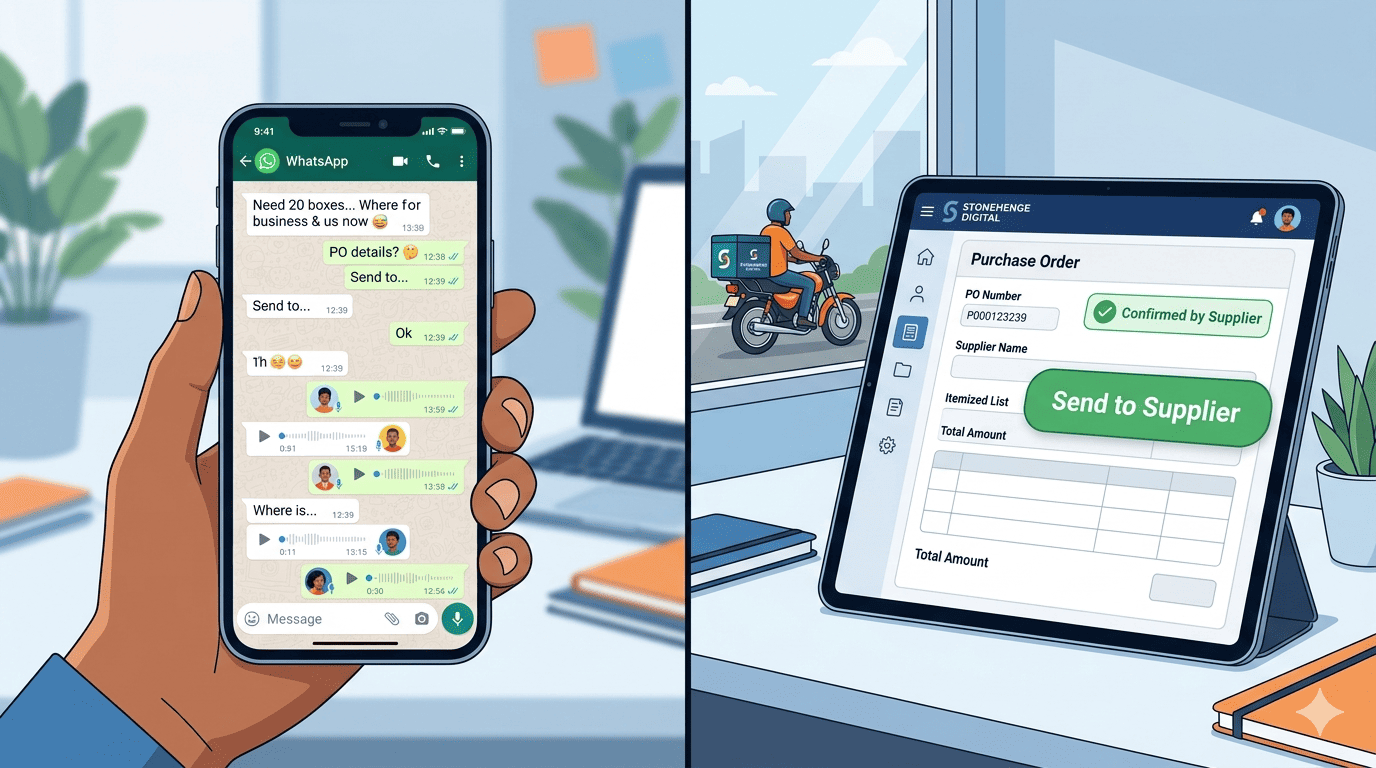
The "Nitumie Bidhaa Zangu" Workflow
You're low on cooking oil. You open WhatsApp. You find the contact "Baba Yao Oils." You record a voice note: "Buda, niko chini ya mafuta. Niletee 20 cartons za 5L. Na utume na nduthi. Asap."
This is the standard Kenyan procurement process. It's fast. It's personal. And it's a nightmare for record-keeping. What was the agreed price? When did it arrive? Did you get 20 cartons or 18?
A Business Management Website with a Purchase Order (PO) module formalizes this relationship without sacrificing the speed.
The Digital Purchase Order Workflow
Instead of a voice note, you (or your manager) use the dashboard to create a PO.
Step 1: Create PO in Dashboard (30 seconds)
- Select Supplier: "Baba Yao Oils."
- Select Item: "Cooking Oil 5L."
- Quantity: 20 cartons.
- Agreed Price (from last time): KES 2,500/carton.
- Click "Generate PO PDF & Send to Supplier."
Step 2: Supplier Receives Structured WhatsApp/Email
The system sends the supplier a clean, professional message:
"PO #1245: 20 Cartons Cooking Oil 5L @ KES 2,500. Delivery: ASAP to CBD Branch. Click to Confirm: [Link]."
When the supplier clicks "Confirm," the PO status updates to "Accepted."
Step 3: Receiving Goods (The Accountability Moment)
When the rider arrives, the manager opens the PO on their phone and clicks "Receive Goods." They can adjust the quantity if only 18 cartons arrived. The system logs the discrepancy and updates the inventory automatically.
Why This Changes Everything
1. Price Memory
No more haggling based on memory. The system shows you what you paid last time, last month, and last year. You can see price trends.
2. Accounts Payable (Who Do I Owe?)
The dashboard maintains a "Creditors" ledger. It shows you exactly how much you owe "Baba Yao Oils" at any given time. No more surprise WhatsApp demands for payment when you're low on cash.
3. Inventory Forecasting
Because POs are linked to inventory, the system can suggest: "Based on your sales velocity, you should order 25 cartons of oil this week, not 20."
Overcoming "Baba Yao" Resistance
"But Baba Yao doesn't use email or dashboards." This is true for many suppliers. That's why the Stonehenge system uses WhatsApp fallback. The supplier receives a simple text message with a link. They don't need to log in. They just need to click "Confirm" or "Decline." It's a bridge between the formal and informal economy.
Interested in Business Management System?
Let's build this for your business
Replace spreadsheets, paper records, and WhatsApp chaos with a custom system built for exactly how your business works.
10 Comments
Restaurant Owner (Nairobi)
23 Apr 2026
The "Price Memory" feature is worth the cost of the whole system. I can't tell you how many times I've overpaid for tomatoes just because I forgot last week's price. This gives me negotiation power.
Distributor (Industrial Area)
23 Apr 2026
I love the "WhatsApp Fallback" strategy. I've tried to get my suppliers to use email or portals. They just ignore it. If the system can send a simple SMS or WhatsApp with a "Confirm" button, they might actually use it. That's the genius bridge. My question: What about partial deliveries? That's the Kenyan reality. "Nimeleta 10 leo, 10 zingine kesho." How does the system handle splitting one PO into multiple receipts? And does it update the inventory as the partials arrive, or only when the full PO is complete? I need to know exactly what's on my shelf right now.
Kevin M.
23 Apr 2026
This turns a chaotic voice note culture into an auditable process. When the taxman asks for purchase records, you have a clean trail. That's compliance gold.
Wanjiku N.
23 Apr 2026
The "Who Do I Owe?" ledger is a lifesaver. I'm always surprised by supplier payment requests. Now I can see my liabilities in real-time.
Brian O.
23 Apr 2026
The "Click to Confirm" link is a great way to get a digital signature/agreement on price. Prevents arguments later about "I didn't agree to that price."
Akinyi O.
23 Apr 2026
This is the missing link between my sales dashboard and my actual costs. Knowing my cost of goods sold in real-time is powerful.
Otieno S.
23 Apr 2026
For large orders, I'd still follow up the WhatsApp link with a voice call. "Buda nimetuma PO, umeiona?" The human touch still matters.
Grace T.
23 Apr 2026
I'm a small shop. Do I really need a PO system? Or is this for bigger distributors? Seems like overkill for my 5 suppliers.
Faith M.
23 Apr 2026
I'm a supplier reading this. If my customers sent me clean POs like this instead of voice notes, I'd give them priority service. It makes my life easier too.
James K.
23 Apr 2026
Great article. Formalizing the supply chain is the next frontier for Kenyan SMEs. It's the only way to scale.