The Worst Thing You Can Say to a Customer
"Imeisha." (It's finished.) You've said it. Your shop assistant has said it. The customer who walked 10 minutes to your shop for a specific product hears those words and leaves disappointed. They might not come back.
Stock-outs are not just a lost sale. They're a trust erosion event. Every "imeisha" chips away at your reliability. The solution is not to overstock (which ties up cash), but to have a smart reorder point alert in your dashboard that tells you before you run out.
What Is a Reorder Point?
It's the minimum quantity of a product you should have on hand before you place a new order. It's calculated based on two factors: average daily sales and supplier lead time. For example, if you sell 5 bags of cement per day, and it takes 3 days for your supplier to deliver, your reorder point is 15 bags. When your stock hits 15, you reorder. By the time it arrives (3 days later), you'll have just sold the last bag.
How the Dashboard Automates This
Step 1: Enter Basic Data
For each product, you (or the system) input: Average Daily Sales (calculated automatically from your POS data over the last 30 days) and Supplier Lead Time (you input once). The dashboard calculates the reorder point.
Step 2: The Alert
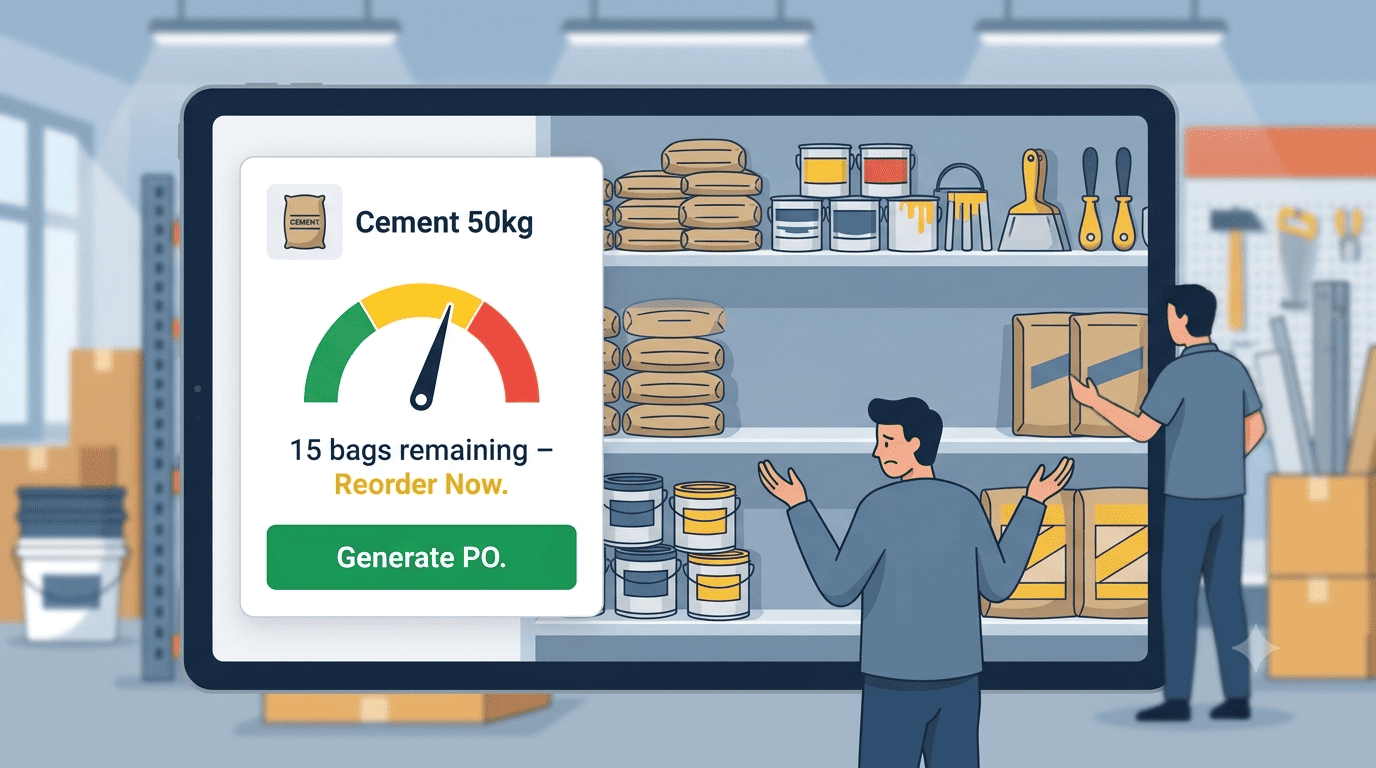
When stock of "Cement 50kg" drops to 15 bags, the dashboard sends you an alert: "Reorder Alert: Cement 50kg is at reorder point (15 bags remaining). Based on current sales velocity, you have 3 days of stock left. Recommended order: 50 bags." The alert can be an in-dashboard notification, an SMS, or a WhatsApp message.
Step 3: One-Click Purchase Order
From the alert, you can click "Generate PO" which auto-fills a purchase order to your cement supplier for the recommended quantity. This saves even more time.
The Dynamic Adjustment
The system isn't static. If sales of cement increase (maybe it's a construction boom), the average daily sales figure rises, and the reorder point adjusts upwards automatically. If sales slow, it adjusts down, preventing over-ordering. This is inventory management that adapts to your business reality.
Never Say "Imeisha" Again
You can't control supply chain disruptions, but you can control your stock levels with data. A simple reorder point alert transforms your inventory management from reactive to proactive. Your customers will thank you with their loyalty.
Interested in Business Management System?
Let's build this for your business
Replace spreadsheets, paper records, and WhatsApp chaos with a custom system built for exactly how your business works.