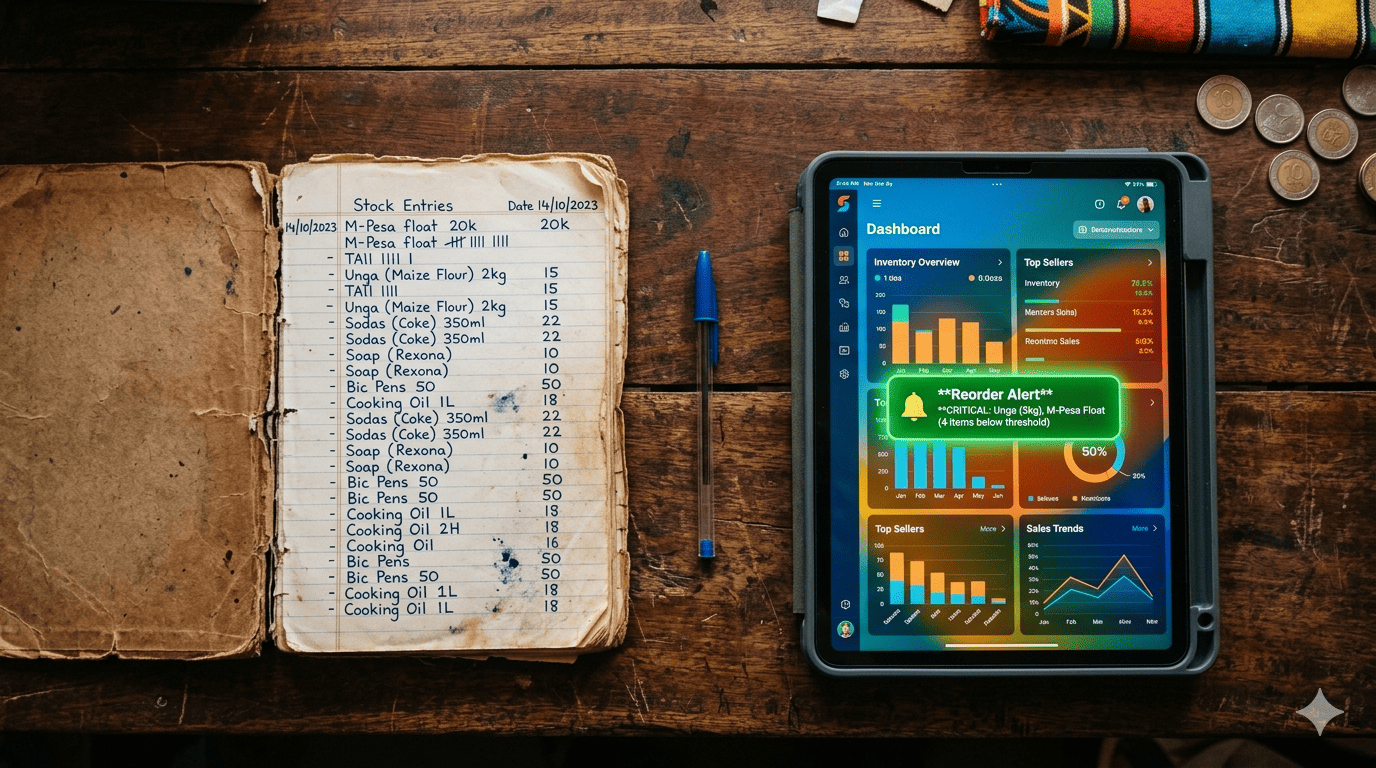
The Silent Killer of Profit: Stock-Outs and Dead Stock
In the back of your shop in River Road or Gikomba, there is a trusty notebook. In it, you (or your manager) scribble: "Rice 50kg - 5 bales." "Sugar - 10 bales." This is the "Kalamu na Kitabu" inventory system. It's been the backbone of Kenyan retail for decades.
But it has two fatal flaws that drain your working capital:
- The Stock-Out: A customer asks for a specific size of cooking oil. You check the book. It says "3 cartons." You go to the back... empty. The book was wrong. You lost a sale.
- The Dead Stock: You have 200 pieces of an item that hasn't sold in 6 months. You didn't notice because the book only shows total stock, not *movement speed*. That's KES 50,000 of cash tied up in unsellable goods.
A Digital Stock Card (built into a Business Management Website) solves both.
What Is a Digital Stock Card?
It's a simple software record of every item you sell. When a sale is processed through the dashboard (or even via an uploaded M-Pesa Till statement), the system automatically deducts the item from inventory. It shows you not just *what* you have, but *how fast* it's moving.
Three Reports That Change Your Buying Decisions
1. The Reorder Alert
Set a minimum threshold (e.g., "Notify me when Rice 50kg drops below 10 bags"). The dashboard sends you an SMS or email. No more manual counting or guessing.
2. The Fast Mover / Slow Mover Report
This report shows you: "Item A: Sold 50 units this month. Item B: Sold 2 units this month."
- Action: Buy more of Item A. Put Item B on "Clearance Sale" at cost price to free up cash.
3. The Gross Profit by Item Report
This is the holy grail. It combines the cost price you entered and the selling price to show you exactly which products are your profit engines.
- Scenario: You sell a lot of Item C (KES 100 margin) and a little of Item D (KES 1,000 margin). The report tells you to focus sales efforts on Item D.
But My Shop Has No Power/Internet?
This is the Kenyan reality. Stonehenge Digital builds "Offline-First" stock management. Your manager can use a mobile app on their phone that saves sales locally. When the internet returns, it syncs to the main dashboard. The book becomes a *backup*, not the primary system.
From Guesswork to Precision
Moving from "Kalamu na Kitabu" to a Digital Stock Card is the single most profitable operational change a Kenyan SME can make. It takes the guesswork out of buying and puts cash back in your bank account.
Interested in Business Management System?
Let's build this for your business
Replace spreadsheets, paper records, and WhatsApp chaos with a custom system built for exactly how your business works.
10 Comments
Hared (Wholesaler, Eastleigh)
25 Apr 2026
The "Dead Stock" point hit me hard. I have a whole shelf of items that haven't moved in months. I need that Slow Mover Report. I'm calling Stonehenge.
Mama Mboga (Grocer)
25 Apr 2026
I like the idea, but the "Offline-First" feature is what I'm most curious about. My shop in Umoja has power cuts every other day. If the system can save sales on the phone and upload later when data comes back, that works for us. My other question: How do you handle bulk breaking? If I buy a 50kg sack of sugar and sell it in 2kg tins, how does the system track that? The notebook can just scribble "Sold 2kg." Does the digital system handle unit conversions easily? That's the complexity that usually stops me from using apps.
Kevin O.
25 Apr 2026
The Gross Profit by Item report is the only thing that matters. I thought I was making money on sodas. Turns out, after transport and chilling, the margin is tiny. I focus on dry goods now.
Wanjiku N.
25 Apr 2026
I've been using a notebook for 15 years. It's scary to change. But the idea of getting a text message when I'm low on stock is very appealing. No more forgetting to order.
Brian T.
25 Apr 2026
For smaller shops, even a simple Google Sheet shared between owner and manager is a step up from the book. But a proper dashboard with alerts is the goal.
Akinyi W.
25 Apr 2026
The "Clearance Sale" advice for dead stock is good business sense. Better to get back KES 40,000 in cash than sit on KES 50,000 worth of dust.
Otieno R.
25 Apr 2026
How do you handle spoilage? If a bag of rice gets weevils, I need to write it off. Can the system log that as "Damaged/Loss" to keep inventory accurate?
Grace M.
25 Apr 2026
This is the difference between a hobby and a business. Tracking inventory properly is how you scale beyond one shop.
Dan K.
25 Apr 2026
I'm a small pharmacy. Expiry date tracking is critical. Does the system alert me when a product is 3 months from expiry? That's a legal requirement.
Faith J.
25 Apr 2026
Great article. I'm going to start with the "Fast Mover" report. I need to know what to restock first.