The Money Left in the Cart
Up to 85 percent of Kenyan online shoppers abandon their carts. Some get distracted, some lose network, some hesitate at the payment step. A well timed SMS sequence can bring a significant portion back.
This tutorial shows you how to set it up, including the copy in Kenyan English and Sheng. It also covers the parts most people skip, which are capturing the contact details and stopping the sequence once the order is placed.
Step 1: Capture the cart and contact info
To recover a cart you need contact info, and the hard truth is that most abandonments happen before the phone number is entered. Solve that problem first.
- Exit intent pop up When a visitor moves to leave, offer a reason to stay and a reason to share a number. Enter your WhatsApp number to save your cart and get a 5 percent discount.
- Partial form capture Save the phone number as soon as it is typed, even if checkout is never completed. This is the single most valuable change on most Kenyan stores.
- Login requirement For repeat customers who are already logged in, the number is already known, so recovery works without any extra step.
Step 2: Set up the recovery timeline
Three messages, three intervals
The customer is likely still nearby. A short message with a direct link performs best here.
Reconnect the product to a reason to buy, such as remaining stock or a specific benefit.
A final message with a light incentive and a clear expiry. After this, stop.
Do not send more than three messages. More than that feels like harassment, and it also trains the customer to ignore your number entirely.
Step 3: Write the messages
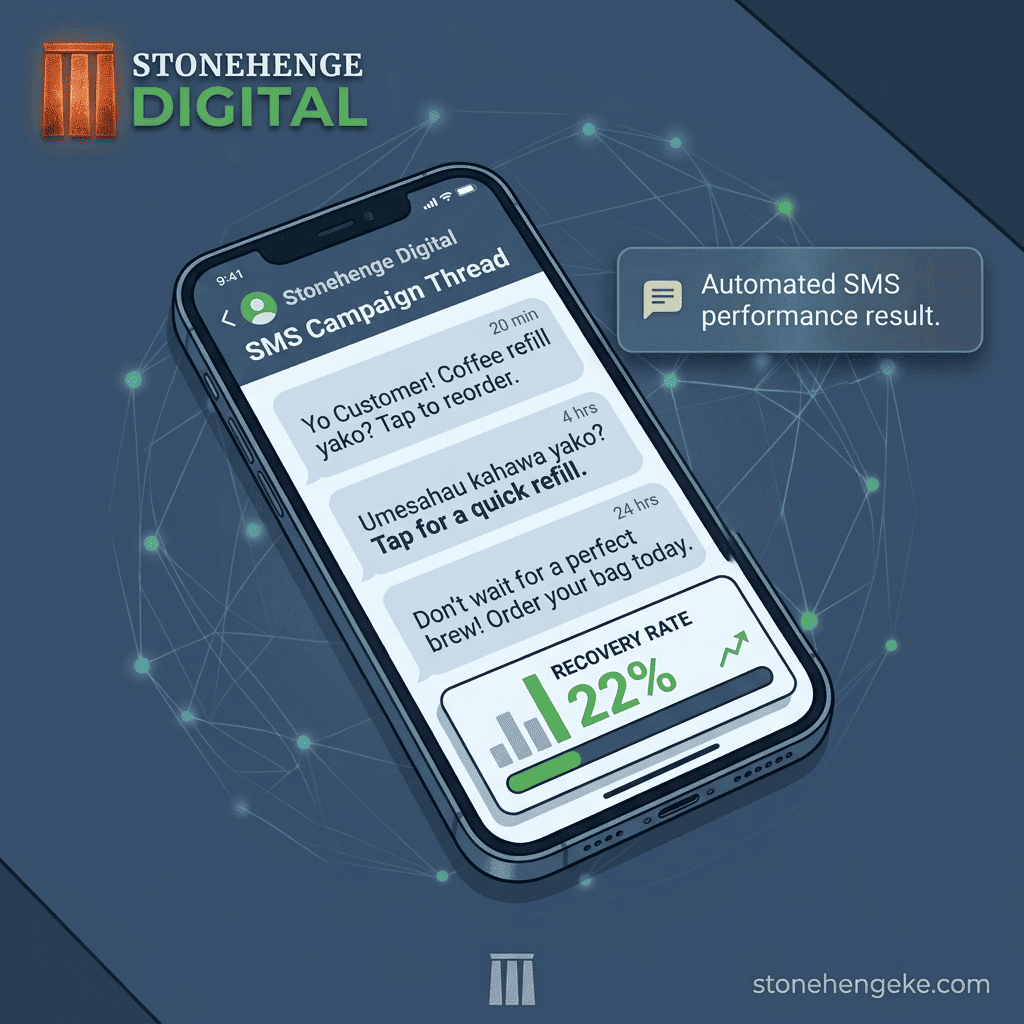
20 minutes, the gentle nudge
"Hi [Name], you left something in your cart! Complete your order in 2 taps: [link]. Need help? Reply HELP. [Brand]"
"Niaje [Name]? Umesahau kitu kwa cart! Complete in 2 taps: [link]. Kuna shida? Reply HELP. [Brand]"
4 hours, the value reminder
"Hi [Name], your [Product Name] is still waiting. We only have [X] left in stock. Complete your order here: [link]. Asante!"
"[Name], hiyo [Product Name] yako iko pending. Stock inaisha! Lipa na hii link: [link]. Asante!"
24 hours, the last chance
"Last chance, [Name]! Your cart expires today. Use code COMEBACK5 for 5 percent off: [link]. We would love to serve you. [Brand]"
"[Name], cart yako ina expire leo! Use code COMEBACK5 for 5 percent off: [link]. Karibu!"
Step 4: Configure in your dashboard
Six settings, one activation
- Go to the marketing section and open abandoned cart recovery.
- Enable the three stage sequence.
- Set the delays at 20 minutes, 4 hours and 24 hours.
- Paste your SMS templates with merge tags for
[Name],[Product Name]and[Link]. - Set a daily cap, for example a maximum of one recovery SMS per customer per day.
- Save and activate.
The daily cap matters more than it looks. Without it, a customer who abandons three carts in one afternoon receives nine messages and unsubscribes from everything, including future order updates.
Step 5: Test the sequence
Run it end to end before launch
- Add a product to the cart.
- Enter your phone number but do not complete payment.
- Wait 20 minutes and check whether the first SMS arrives.
- Click the link and verify it opens a pre filled checkout.
- Complete the purchase and verify the sequence stops with no further messages.
The final step is the one most teams forget to test. A sequence that keeps sending messages after a completed order looks careless, and it is a quick way to lose an otherwise happy customer.
Step 6: Monitor and optimise
Three numbers tell you whether the sequence is working or just adding noise.
- Recovery rate The percentage of abandoned carts recovered. Track it weekly, not just at month end.
- Message performance Which of the three messages drives the most recoveries. If message three does most of the work, your first message is too weak.
- Unsubscribe rate If it climbs, your messages are too aggressive or too frequent. Reduce before you lose the list.
The revenue impact
A Stonehenge Digital client recovered KSh 120,000 in a single month from abandoned carts using this exact sequence. The 20 minute SMS alone recovered 40 percent of those. Speed and tone matter.
A pre launch checklist
- Phone numbers are captured before the payment step
- Each message links to a pre filled checkout
- Merge tags work correctly for name and product
- Both Kenyan English and Sheng versions are ready
- Delays are set at 20 minutes, 4 hours and 24 hours
- A daily cap prevents message flooding
- The sequence stops after a completed order
- Replies to HELP reach a real person or an automatic answer
- Recovery rate and unsubscribe rate are being tracked
Set up your recovery sequence today. The money is sitting in those carts.
Capture the number, send three messages at sensible intervals, write in the language your customer actually uses, and stop the moment the order is complete.
Want abandoned cart recovery built in?
Stonehenge Digital builds e commerce checkouts with partial number capture, three stage SMS recovery, pre filled cart links and a dashboard showing recovery rate by message.
Set Up Abandoned Cart Recovery →Interested in E-Commerce Website with M-Pesa?
Let's build this for your business
Sell to any Kenyan with a phone. Full online shop with Safaricom STK Push payment — no card needed.